A reader story
For years I honestly thought I was just lazy.
Not "a bit disorganised". Not "busy". Lazy. That was the word I used about myself, privately, for most of my twenties.

⚡ Limited offer — $97 → $27
Get the 4 workbooks — $27 →Instant download · 30-day money-back guarantee
I want to describe one specific kind of afternoon, because if it means nothing to you, the rest of this won't either.
There is a task. It is not hard. An email that takes four minutes, a form, one phone call. I know exactly what to do. I have known for eleven days. And I sit there, and I do not do it.
Not because I'm doing something better. I'm doing nothing. I'm on my phone, or staring at a wall, and the whole time a voice is running underneath: this is pathetic, it's a four-minute job, what is wrong with you.
That was the part that hurt. The people I knew weren't smarter or more disciplined. They just seemed to have something I didn't: the ability to decide on a thing and then simply begin it. No negotiation. No dread. They started.
So I did what anyone does when they can't explain a gap like that. I decided the gap was my character.
The evidence I collected against myself
What made the verdict so convincing is that the evidence was everywhere, every single day, and all of it was small enough to be embarrassing:
The remote control. Missing three days. Found in the fridge, on the shelf, beside the milk. No memory of putting it there.
The cleaning spray. Started on the kitchen at eleven. By one, the kitchen was worse than when I began, and I had somehow reorganised a cupboard nobody opens.
The laundry. Clean, dry, folded. It lived on top of the machine for nine days, because putting it away was a separate task — and separate tasks mean starting again.
The evening that vanished. Sat down at eight to do one thing. Looked up at midnight having done a different thing, brilliantly, that nobody had asked for.
Any one of those is a funny story you tell at dinner. All of them, every week, for years, is something else entirely. It stops being a story and turns into a verdict.
The answer wasn't the one I expected
It turned out the question itself was wrong. Not "what is wrong with me", but "what is this system actually doing?"
Here is the part that reframed everything. The brain runs a set of functions that handle starting, sequencing, holding a plan in mind, and switching between things — the executive functions. They don't run on how much you care about an outcome. They run on how much signal a task is generating right now.
A task with no visible first step generates almost no signal. So the system doesn't start it. Not "won't" — doesn't. And caring more about the result changes nothing, because caring was never the input.
Which finally explained the thing that had made no sense for fifteen years: I could disappear for nine hours into something nobody asked for, and be unable to spend four minutes on something I genuinely needed. It was never willpower. It was which task the system could get a grip on.
Why the usual advice kept failing
Every productivity system I tried assumed the hard part was knowing what to do. A better calendar. A better list. A better app. But I always knew what to do. The hard part was the two feet between knowing and beginning — and a calendar has nothing whatsoever to say about that gap.
Worse: every abandoned app became another piece of evidence for the verdict. I wasn't only failing at the task. I was failing at the thing that was supposed to fix the task.
What actually moved
What helped in the end wasn't another system. It was sitting down with a page that asked me one question at a time and left room to answer it.
David is an ADHD coach. He didn't set out to make something to sell — he started making pages for his wife, after she was diagnosed and everything they bought to help turned out to be written for a brain that can sit through twelve pages of theory. She'd stall around page four and add it to the pile of things she'd failed at.
So he made pages she would actually finish. Short. One idea each. Somewhere to write. Built on CBT and ACT frameworks, minus the clinical language. She finished them. Then a friend asked for a copy, then another.
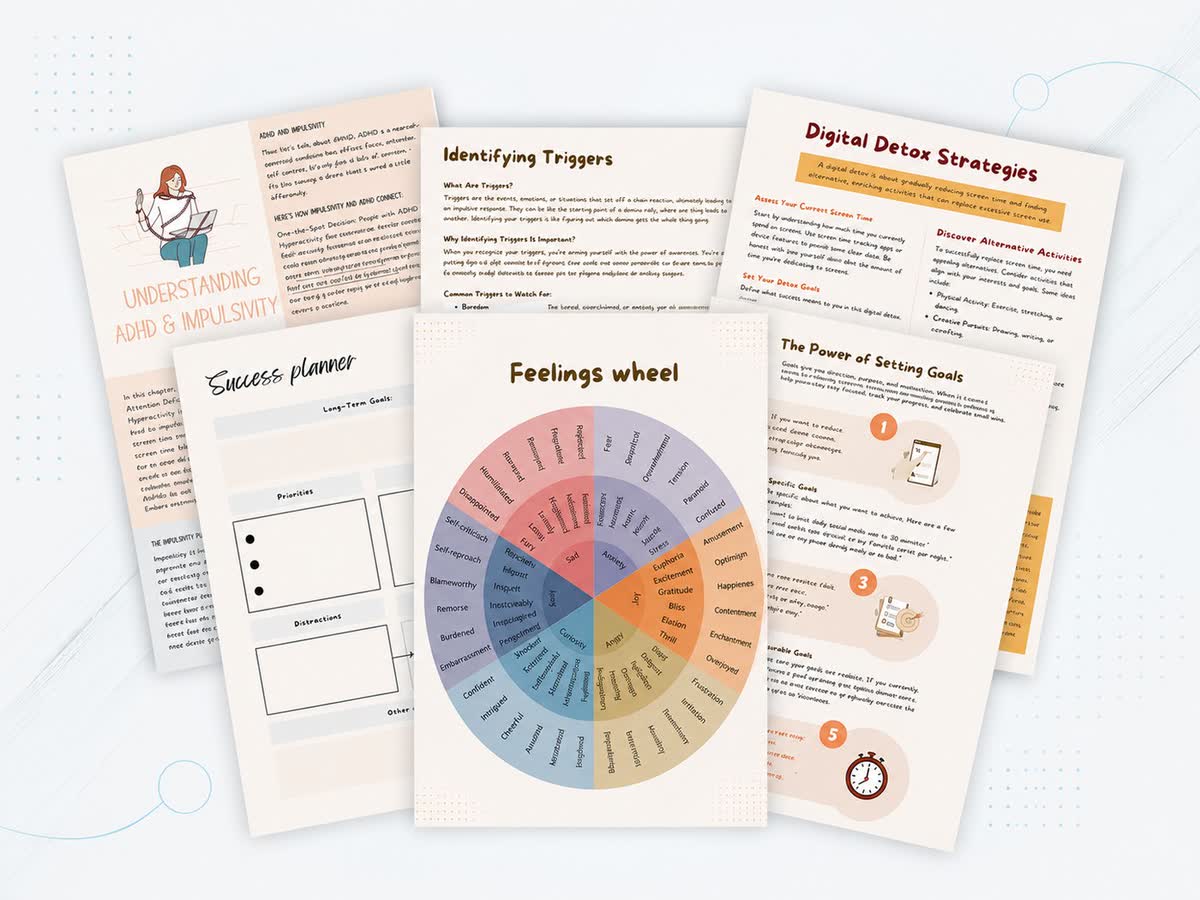
The one that changed most for me was the workbook on shame and the inner critic. Not because it made the critic go quiet, but because writing down what it actually says — in its own words, on a page, in my handwriting — made it sound like what it is. A recording. Not a diagnosis.
It finally helped me understand how my brain works — which sounds like a small thing, until you've spent fifteen years assuming the answer was that you were lazy.
The Transformation Pack
The four workbooks that came out of all this. 123 pages, printable or fillable on screen.
- 01Hidden Depths — what sits under the surface: shame, rejection sensitivity, masking
- 02Spinning Emotions — regulation, for feelings that arrive at full volume
- 03Ctrl+ADHD+Del — the screen loop, and a 100-day reset challenge
- 04ADHD Ventures — building work around how this brain actually operates
No subscription. No upsells. Yours forever.
Get the 4 workbooks →🔒 Secure checkout by Stripe · Instant digital download (PDF) · 30-day money-back guarantee, no questions asked
What's actually inside
Four workbooks, 123 pages in total. Every page stands on its own — open it anywhere, do one page, close it. Putting it down for three weeks costs you nothing.
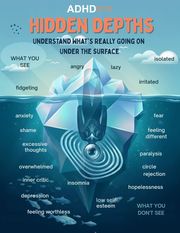
Hidden Depths
The ADHD iceberg: what people see, and what actually drives it.
28 pages
Spinning Emotions
Naming and regulating emotions that arrive without a volume dial.
32 pages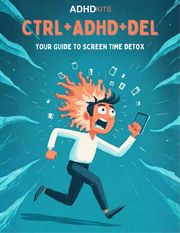
Ctrl+ADHD+Del
Breaking the scroll loop, with a 100-day dopamine reset challenge.
31 pages
ADHD Ventures
Turning how this brain works into something that pays.
32 pagesWhat readers wrote back

I just finished the Iceberg workbook. I honestly didn't expect it to hit me that hard. The “what's under the surface” part made me realise so much about myself — for the first time, I understand why I've been so hard on myself my whole life.

I finished the Ctrl+ADHD+Del challenge. I finally stopped scrolling for hours.

I've tried therapy before. It did help — but these workbooks gave me practical tools I actually use every day.
*Shared with permission, names shortened. Individual results may vary — testimonials reflect the personal experience of individual customers and are not representative of all users.
What you're actually getting
No claims about how fast it works or how you'll feel. Just what is in the file, and what happens if it isn't for you.
Read all 123 pages. If it doesn't help, email us within 30 days and you get every cent back — no questions, no form to fill in, no explanation required. The risk sits with us, not with you.
Before you decide
I've never finished a workbook in my life.
Neither had I. These aren't built to be finished — they're built to be opened. Every page stands alone: one idea, one exercise, one blank space. Nothing on page 40 depends on page 6, so there's no order to respect and no streak to break.
Is this a replacement for therapy or medication?
No, and it isn't meant to be. These are educational self-help workbooks. They don't diagnose anything and they don't replace a professional. What they do is give you something to work with between sessions, or while you're on a waitlist, or if therapy isn't affordable right now.
Do I need a diagnosis?
No. Diagnosed, waiting, wondering, or simply recognising the struggles — the exercises apply either way. They are educational tools, not medical advice.
What exactly do I receive, and how fast?
One ZIP file containing 4 PDF workbooks, 123 pages in total. Printable, or fillable on screen on any device. The download link appears immediately after checkout and is emailed to you as well.
What if it isn't for me?
There is a 30-day money-back guarantee. Email us within 30 days and you get a full refund, no questions asked.
Is my payment secure?
Checkout is handled entirely by Stripe, with encrypted PCI-compliant processing. We never see or store card details.
One last thing
If you recognised the afternoon I described at the top — the four-minute task, the eleven days, the voice underneath — then the most useful thing I can pass on is the thing that took me fifteen years to hear.
It was never that I didn't care enough. I'd been handed the wrong explanation, and I had believed it.
Get the 4 workbooks — $27 →Instant download · 30-day money-back guarantee